

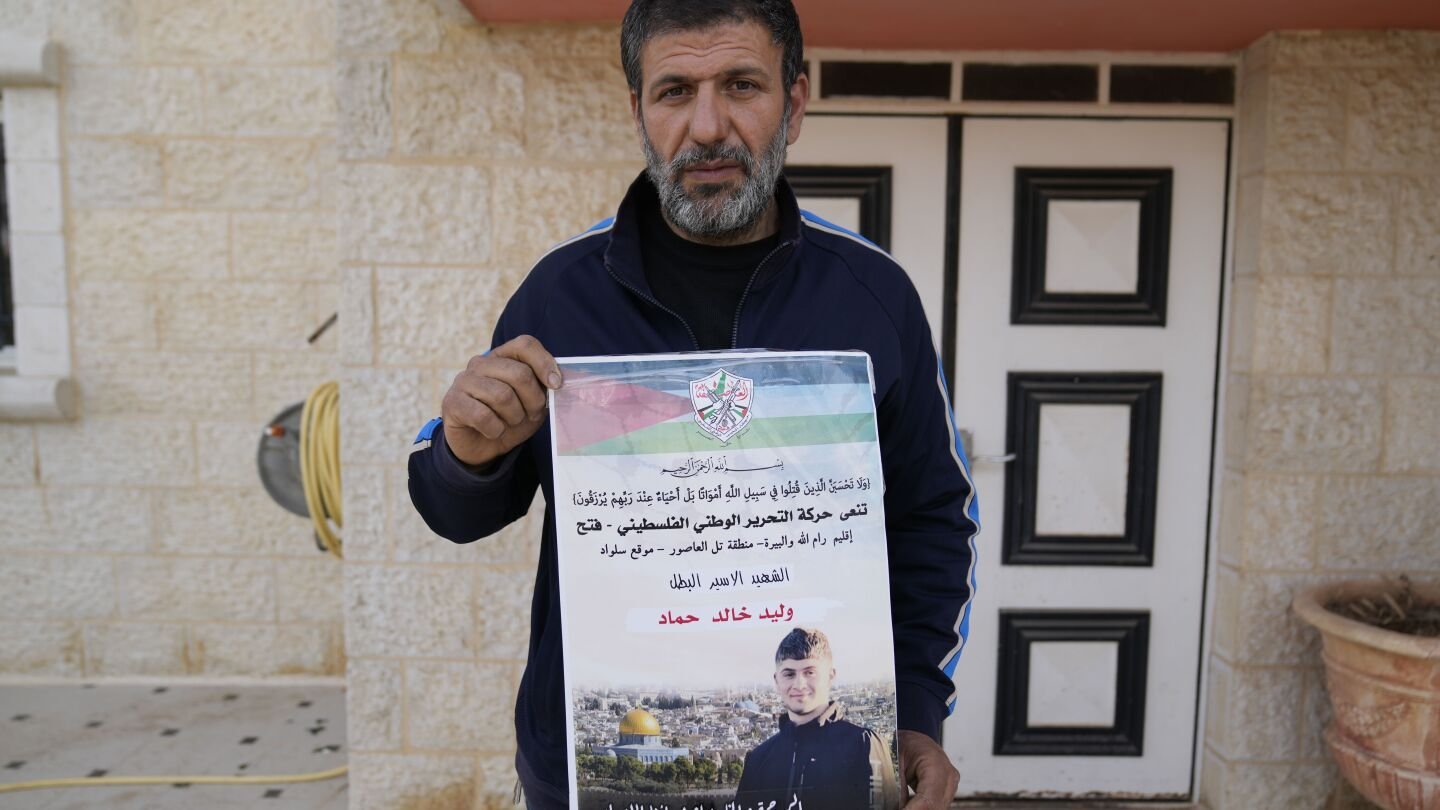
JERUSALEM (news agencies) — A 17-year-old from the West Bank who was held in an Israeli prison for six months without being charged died after collapsing in unclear circumstances, becoming the first Palestinian teen to die in Israeli detention, officials said.
Walid Ahmad was a healthy high schooler before his arrest in September for allegedly throwing stones at soldiers, his family said. Rights groups have documented widespread abuse in Israeli detention facilities holding thousands of Palestinians who were rounded up after Hamas’ Oct. 7, 2023, attack ignited the war in the Gaza Strip.
Prison authorities deny any systematic abuse and say they investigate accusations of wrongdoing by prison staff. But the Israeli ministry overseeing prisons acknowledges conditions inside detention facilities have been reduced to the minimum level allowed under Israeli law.
Israel’s prison service did not respond to questions about the cause of death. It said only that a 17-year-old from the West Bank had died in Megiddo Prison, a facility that has previously been accused of abusing Palestinian inmates, “with his medical condition being kept confidential.” It said it investigates all deaths in detention.
Khalid Ahmad, Walid’s father, said his son was a lively teen who enjoyed playing soccer before he was taken from his home in the occupied West Bank during a pre-dawn arrest raid.
Six months later, after several brief court appearances during which no trial date was set, Walid collapsed on March 23 in a prison yard and struck his head, dying soon after, Palestinians officials said, citing eyewitness accounts from other prisoners.
The family believes Walid contracted amoebic dysentery from the poor conditions in the prison, an infection that causes diarrhea, vomiting and dizziness — and can be fatal if left untreated.
Walid is the 63rd Palestinian prisoner from the West Bank or Gaza to die in Israeli custody since the start of the war, according to the Western-backed Palestinian Authority, which administers parts of the West Bank. Palestinian prisoner rights groups say that is about one-fifth of the roughly 300 Palestinians who have died in Israeli custody since the 1967 Mideast war, when Israel captured the West Bank, Gaza and east Jerusalem. The Palestinians want all three territories for their future state.
The Palestinian Authority says Israel is holding the bodies of 72 Palestinian prisoners who died in Israeli jails, including 61 who died since the beginning of the war.
Conditions in Israeli prisons have worsened since the start of the war, former detainees told media. They described beatings, severe overcrowding, insufficient medical care, scabies outbreaks and poor sanitary conditions.
Israel’s National Security Ministry, which oversees the prison service and is run by ultranationalist Cabinet Minister Itamar Ben-Gvir, has boasted of reducing the conditions of Palestinian detainees “to the minimum required by law.” It says the policy is aimed at deterring attacks.
Israel has rounded up thousands of Palestinians in the Gaza Strip and the West Bank, saying it suspects them of militancy. Many have been held for months without charge or trial in what is known as administrative detention, which Israel justifies as a necessary security measure. Others are arrested on suspicion of aggression toward soldiers but have their trials continuously delayed, as the military and Israel’s security services gather evidence.
Walid sat through at least four court appearances over videoconference, his father said, but each time the judge delayed, eventually setting an April 21 trial date. Each session was about three minutes, Walid’s father said.
In a February session, four months after Walid was detained, his father noticed that his son appeared to be in poor health.
“His body was weakened due to malnutrition in the prisons in general,” the elder Ahmad said. He said Walid told him he had gotten scabies — a contagious skin rash caused by mites that causes intense itching— but had been cured.

