

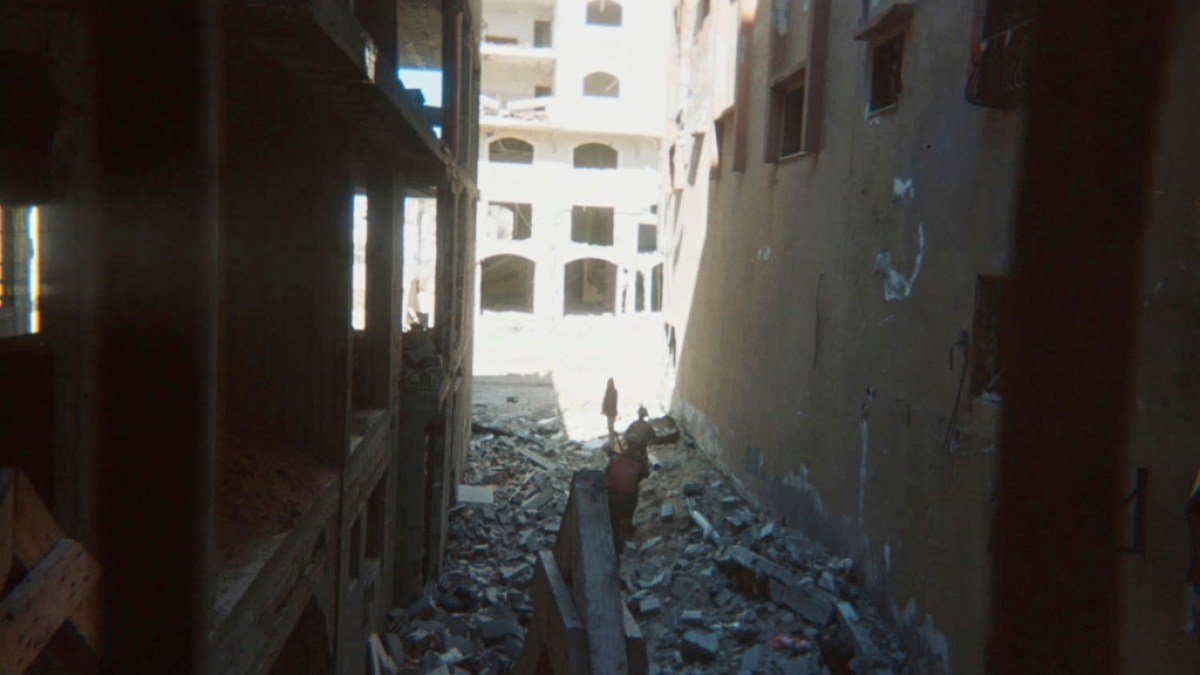
Army under pressure to provide answers amid growing evidence that orders to use Palestinians as ‘fodder’ come from top.
A recent report by The Associated Press that exposed the Israeli military’s “systematic” use of Palestinians as human shields has shone a light on an illegal practice that has become commonplace over the 19-month war in Gaza and parallel offensives in the West Bank.
The report, published on Saturday, featured the testimonies of seven Palestinians who had been used as human shields in Gaza as well as the occupied West Bank, with two Israeli military officers confirming the ubiquity of the practice, which is considered a violation of international law.
Responding to the allegations, Israel’s military told the news agency that using civilians as shields in its operations was strictly prohibited and that several cases were under investigation.
So what are human shields? How widely have they been used by the Israeli military? And is Israel likely to launch a crackdown any time soon?
Under international humanitarian law (IHL), the term “human shields” refers to the use of civilians or other protected persons, whether voluntary or involuntary, in order to shield military targets from attacks.
The use of human shields in warfare is prohibited under IHL, but Israeli soldiers have allegedly employed it widely during the Gaza genocide.
Earlier this year, Israeli newspaper Haaretz published the first-hand testimony of an Israeli soldier who said that the practice had been used “six times a day” in his unit and that it had effectively been “normalised” in military ranks.
Back in August, the newspaper had revealed that Palestinians used as human shields in Gaza tended to be in their 20s and were used for periods of up to a week by units, which took pride in “locating” detainees to send into tunnel shafts and buildings.
“What we have now in the live-streamed genocide is the most documented archive of human shielding in the history of the different wars between Israel and the Palestinians,” he said.
“What we have discovered is precisely that it is a systematic practice.”
Throughout the conflict, the Israeli military’s response to allegations has been to withhold comment, to point to a lack of details, or, when faced with undeniable proof, to announce a probe.
Last year, Israel declined to respond to a range of allegations put to it by media’s Investigative Unit, which examined thousands of photos and videos – the bulk of them posted online by Israeli soldiers – and testimonies pointing to a number of potential war crimes, including the use of human shields.
Among the atrocities revealed by the team in the resulting documentary was the case of Jamal Abu al-Ola, a detainee forced to act as a messenger by the Israelis. Footage showed the young man dressed in a white hazmat suit, with hands bound and head wrapped in a yellow cloth, telling displaced people at the Nasser Hospital in Khan Younis to evacuate. His mother followed him out, and witnessed him being shot dead by a sniper.
What are human shields, and how has Israel used them?
Commenting on the case for the documentary, Rodney Dixon, an international law expert, said that al-Ola had been used as a “military asset”, which was “in many ways the definition of using persons as a human shield”.
This year, the military pushed back on calls to investigate a report on an 80-year-old man forced to act as a human shield in Gaza City, saying that “additional details” were needed.
However, the military will acknowledge violations when confronted with undeniable evidence provoking widespread outrage, such as last year’s video of wounded Palestinian man Mujahed Azmi, strapped to the hood of an army jeep during a raid on the West Bank city of Jenin.
That particular case was described as “human shielding in action” by Francesca Albanese, the United Nations’ special rapporteur to the occupied Palestinian territory.
In a statement, Israel’s military said its forces were fired at and exchanged fire, wounding a suspect and apprehending him. It added that the “conduct of the forces in the video” did not “conform to the values” of the military and that the incident would be investigated.
However, as Perugini observes, the very reason why the International Criminal Court (ICC) has issued arrest warrants for Prime Minister Benjamin Netanyahu and former Defence Minister Yoav Gallant for alleged war crimes in Gaza is because legal experts doubt Israel’s ability to investigate itself.
Despite vast evidence, the question of whether the military will be launching a crackdown aimed at banishing the apparently systematic practice is moot. Even so, pressure for accountability is growing.
Rights groups say the practice of using human shields has been going on in the occupied Palestinian territories for decades. Breaking the Silence, a whistle-blower group gathering testimonies of former Israeli soldiers, cites evidence of what one high-ranking officer posted to Bethlehem in the occupied West Bank back in 2002 called “neighbour procedure”.
“You order a Palestinian to accompany you and to open the door of the house you want to enter, to knock on the door and ask to enter, with a very simple objective: if the door blows up, a Palestinian will be blown up, and soldiers won’t be blown up,” said the officer, ranked as a major.
In 2005, an Israeli Supreme Court ruling explicitly barred the practice. Five years later, two soldiers were convicted of using a nine-year-old boy as a human shield to check suspected booby traps in the Gaza City suburb of Tal al-Hawa.
It was reportedly the first such conviction in Israel.

