

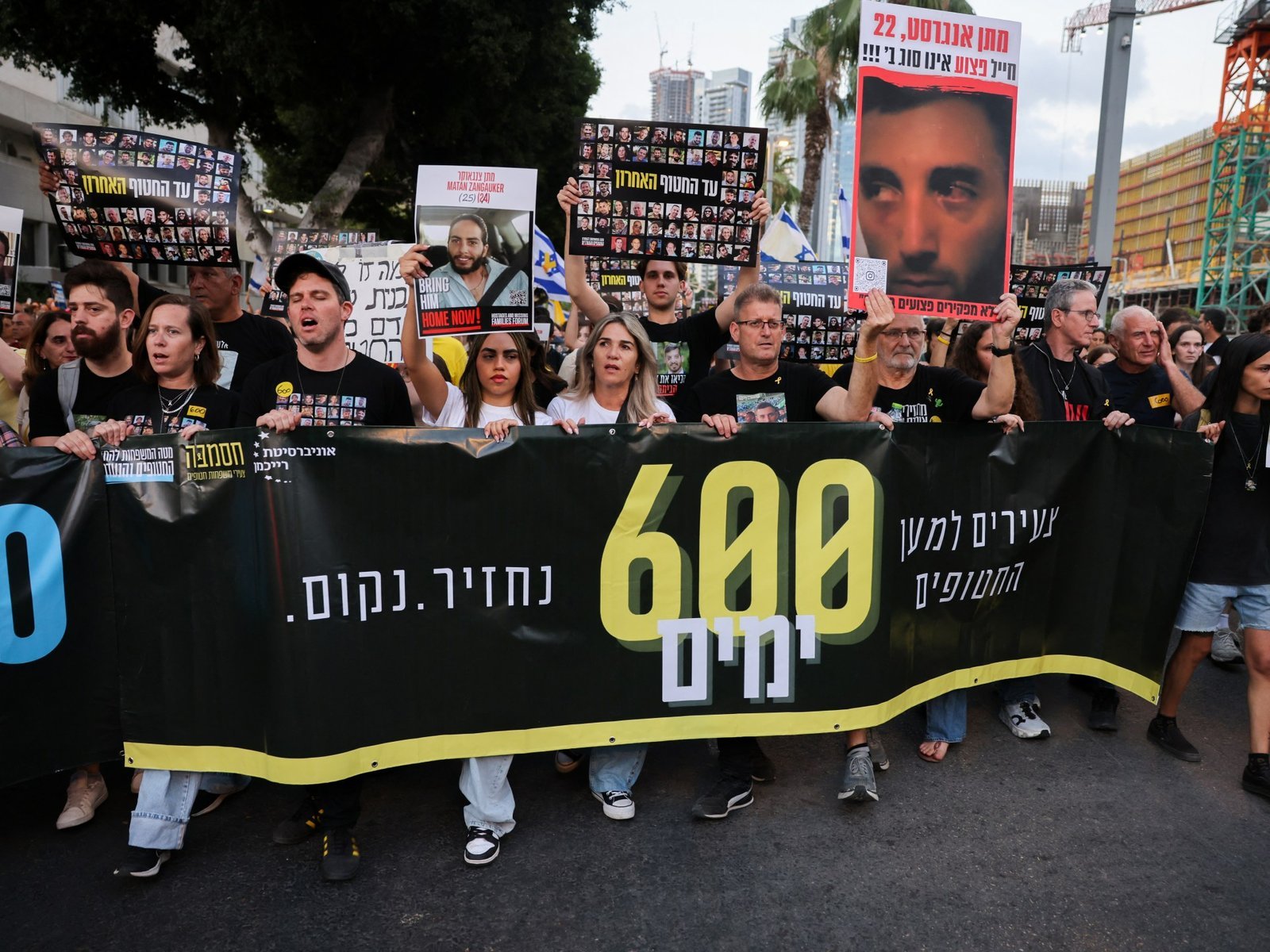
Israel faces growing internal divisions as protests and refusal of military service gain momentum amid Gaza conflict.
As Israel’s devastating war on Gaza grinds on, pushed forward by a prime minister insistent that a goal of total military victory be met, the divisions within Israeli society are growing increasingly deeper.
In the last few weeks, as Israeli peace activists and antiwar groups have stepped up their campaign against the conflict, supporters of the war have also increased their pressure to continue, whatever its humanitarian, political or diplomatic cost.
Members of the military have published open letters protesting the political motivations for continuing the war on Gaza, or claiming that the latest offensive, which is systematically razing Gaza, risks the remaining Israeli captives held in the Palestinian territory.
Another open letter has come from within Israel’s universities and colleges, with its signatories doing a rare thing within Israel since the war began in October 2023: focusing on Palestinian suffering.
Elsewhere, campaigns of protest and refusal of military service have spread – a result of a mixture of pro-peace sentiment and more prevalent anger at the government’s handling of the war – posing a risk to Israel’s war effort, which is reliant upon the active participation of the country’s youth.
The war’s critics say that the man they oppose, Prime Minister Benjamin Netanyahu, has become reliant upon the extreme right to maintain his coalition, and an opposition too cowardly to confront him in the face of mounting international accusations of genocide.
And on Monday, thousands of Israelis led by the country’s far-right national security minister, Itamar Ben-Gvir, rampaged through occupied East Jerusalem’s Old City, chanting “death to Arabs” and attacking anyone perceived to be either Palestinian or defending them.
Also addressing the crowd at the “Jerusalem Day” march was the country’s ultranationalist finance minister, Bezalel Smotrich, who has been vocal in his push for the annexation of the occupied West Bank, and the displacement of Palestinians from Gaza.
Smotrich asked the crowd: “Are we afraid of victory?”; “Are we afraid of the word ‘occupation?’” The crowd – described as “revellers” within parts of Israeli media – responded with a resounding “no”.
“There’s a cohort of the extreme right who feel vindicated by a year and a half of war,” the former Israeli diplomat Alon Pinkas told media. “They think their message that, if you blink you lose; if you pause, you lose; if you waver, you lose, has been borne out.”
Powerful far right
Alongside the intensifying of Israel’s onslaught on Gaza, which has now killed more than 54,000 Palestinians, voices of dissent have grown louder. In April, more than 1,000 serving and retired pilots issued an open letter protesting a war they said served “political and personal interests” rather than security ones. Further letters, as well as an organised campaign encouraging young Israelis to refuse to show up for military service, have followed.
Cassif, who refers to himself as an anti-Zionist, has long attracted the outrage of mainstream Israeli society for his loud denunciation of the way Israel treats Palestinians.
“There have always been threats against me,” Cassif, who has been alone among Israeli lawmakers in opposing the war from its onset, told media. “I can’t walk down my own street. I was attacked twice before October 7 and it’s gotten much worse since.
“But it’s not just me. All the peace activists risk being physically attacked or threatened, even the families of the hostages are at risk of attack by these bigots,” he said.
“Many people are coming to realise that this government and even the mainstream opposition aren’t fighting a war for security reasons, or even to recover the hostages, but are carrying out the kind of genocidal mission advocated by Smotrich and the other messianic bigots,” Cassif said of the finance minister and his supporters.
“This has been allowed by people like [Benny] Gantz, [Yair] Lapid and [Yoav] Gallant,” he said, citing prominent politicians opposed to the prime minister, “who didn’t dare criticise it [the war] and Netanyahu, who has manipulated it for his own ends.”
Cassif’s comments were echoed by one of the signatories to the academics’ open letter criticising the war, Ayelet Ben-Yishai, an associate professor at the University of Haifa.
“The opposition has nothing,” she told media. “I get that it’s hard to argue for a complicated future, but they do and say nothing. All they’ve left us with is a choice between managing the war and the occupation and Smotrich and his followers. That’s it. What kind of future is that?”
Many members of the government and opposition have previously served in senior roles within the army, either engaging in or overseeing combat operations against Palestinians, and maintaining the illegal occupation of Palestinian land.
Democrats Party head Golan was even previously criticised by the army in 2007 for repeatedly using Palestinian civilians as human shields.

