

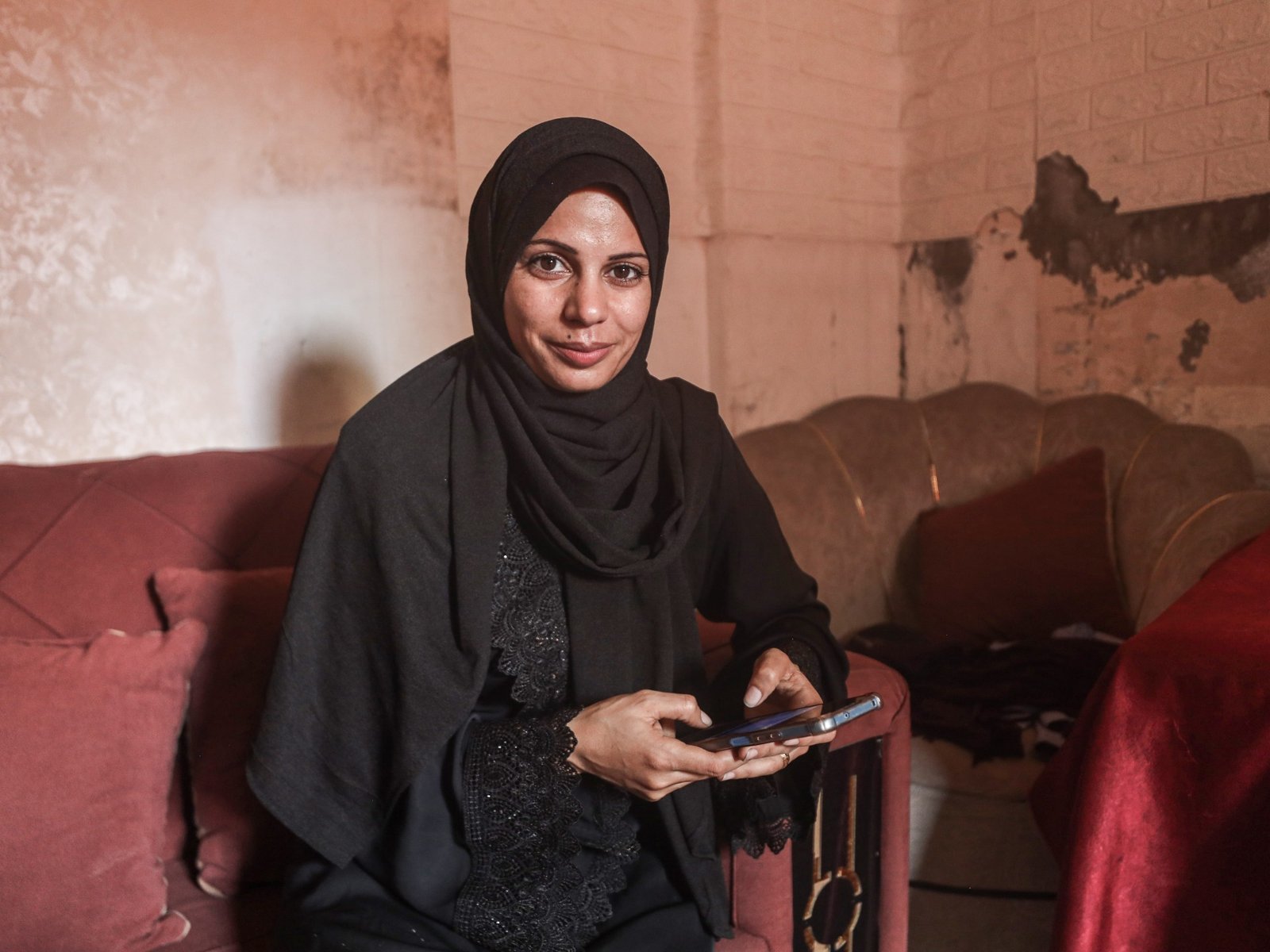
Madleen Kulab says she is ‘deeply moved’ to hear that a vessel aiming to break the siege of Gaza is named after her.
Gaza City – As the Madleen sails towards Gaza to try to deliver life-saving aid to its people, little is known about the woman the boat was named after: Madleen Kulab, Gaza’s only fisherwoman.
When media first met Madleen Kulab (also spelled Madelyn Culab) three years ago, she had two children, was expecting her third and lived a relatively quiet life in Gaza City with her husband, Khader Bakr, 32, also a fisherman.
Madleen, now 30, would sail fearlessly out as far as Israel’s gunship blockade would allow to bring back fish she could sell in a local market to support the family.
When Israel’s war on Gaza began, the family was terrified, then heartbroken when Israel killed Madleen’s father in an air strike near their home in November 2023.
They fled with Madleen nearly nine months pregnant to Khan Younis, then to Rafah, to Deir el-Balah and then Nuseirat.
Now, they are back in what remains of their home in Gaza City, a badly damaged space they returned to when the Israeli army allowed displaced people to head back north in January.
“I was deeply moved. I felt an enormous sense of responsibility and a little pride,” she says with a smile.
“I’m grateful to these activists who have devoted themselves, left their lives and comforts behind, and stood with Gaza despite all the risks,” she says of the group of 12 activists, who include Swedish climate activist Greta Thunberg and Rima Hassan, a French member of the European Parliament.
“This is the highest form of humanity and self-sacrifice in the face of danger.”
Khader sits on another sofa with six-year-old Sandy. He holds out his phone with a photo of the Madleen on it, flying the Palestinian flag.
Madleen has been fishing since she was 15, a familiar figure heading out on her father’s boat, getting to know all the other fishermen and also becoming well-known to international solidarity activists.
Responsibility and pride
In addition to bringing home the fish, Madleen is also a skilled cook, preparing seasonal fish dishes that were so famously tasty that she had a list of clients waiting to buy them from her. Especially popular were the dishes made with Gaza’s ubiquitous sardines.
But now, she can’t fish any more and neither can Khader because Israel destroyed their boats and an entire storage room full of fishing gear during the war.
“Now fish is too expensive if you can find it at all. Only a few fishermen still have any gear left, and they risk their lives just to catch a little,” she says.
“Everything has changed. We now crave fish in the middle of this famine we’re living through.”
After the air strike near the family home in November 2023, Madleen’s family’s first displacement was to Khan Younis, following Israeli army instructions that they would be safer there.
After searching for shelter, they ended up in a small apartment with 40 other displaced relatives, and then Madleen went into labour.
“It was a difficult, brutal birth. No pain relief, no medical care. I was forced to leave the hospital right after giving birth. There were no beds available because of the overwhelming number of wounded,” she says.
When she returned to the shelter, things were just as dire. “We didn’t have a mattress or even a blanket, neither me nor the kids,” she said.
“I had to sleep on the floor with my newborn baby. It was physically exhausting.”
She then had to tend to four children in an enclave where baby formula, diapers and even the most basic food items were almost impossible to find.
The war, she says, has reshaped her understanding of suffering and hardship.
In 2022, she and Khader were struggling to make ends meet between Israel’s gunship blockade and the frequent destruction of their boats. There was also the added burden of being a mother with small children and undertaking such physically taxing work.
But now, things have gotten far worse.

