

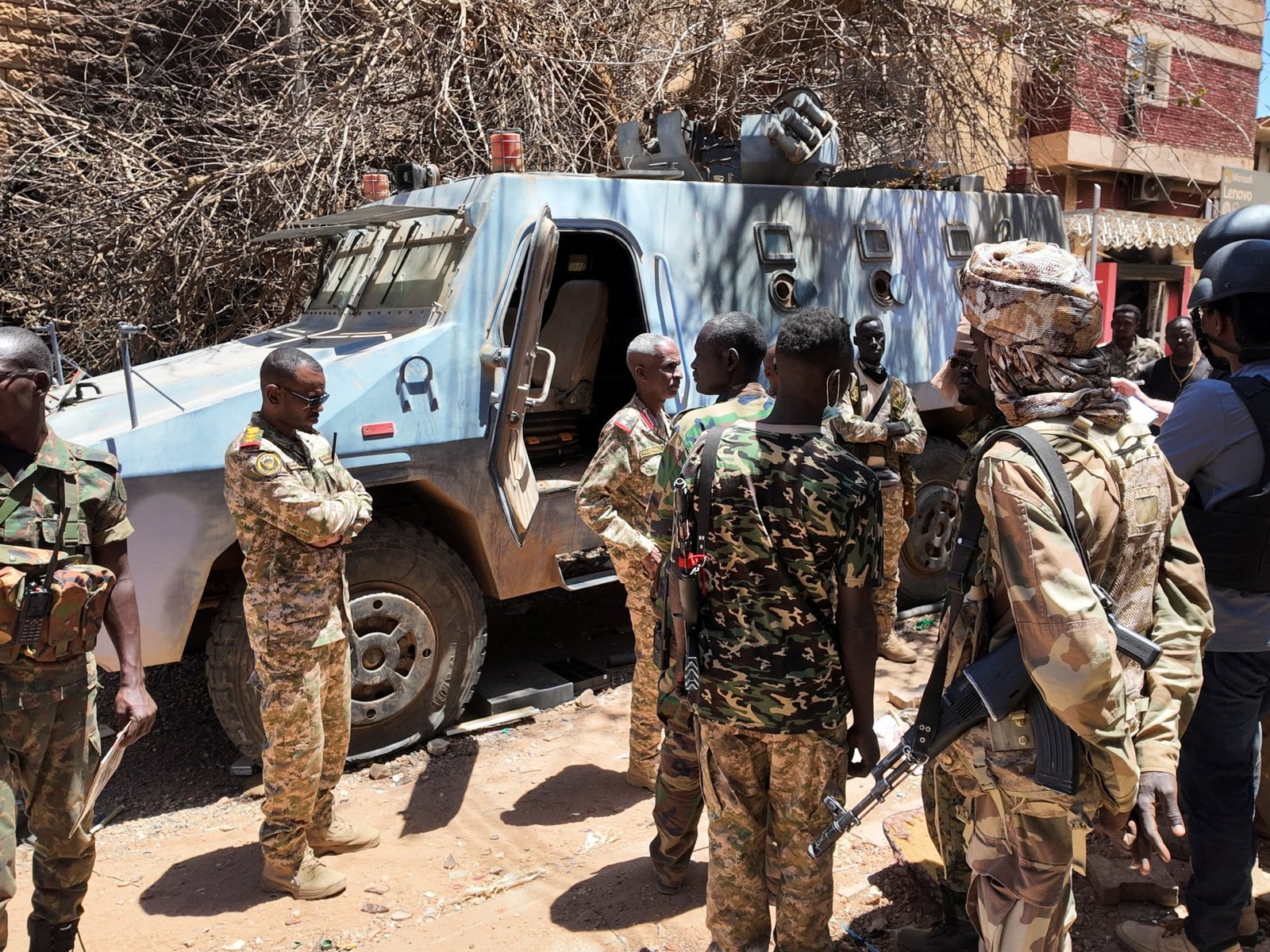
Both the army-backed government and RSF-backed alliance are increasingly rewarding loyal armed groups on the ground.
In June, the Sudanese Armed Forces appointed Prime Minister Kamil Idris to lead the civilian cabinet in Port Sudan, the wartime capital on the Red Sea coast.
Idris wanted an overhaul, to appoint a team of technocrats to run the new government.
But Gebreil Ibrahim and Mini Arko Minawi – leaders of two powerful armed groups from Darfur – refused to leave their posts, and army leader Abdelfattah al-Burhan overruled Idris to keep them there.
“Burhan’s concession to Ibrahim and Minawi allows them to keep ministries that control [government] revenue,” said Suliman Baldo, the founder of the Sudan Transparency and Policy Tracker, a think tank.
media sent written questions to army spokesperson Nabil Abdullah, asking him why al-Burhan overruled Idris. No response had been received by the time of publication.
On the other side of the war is a coalition of armed groups that have, de facto, divided Sudan in half after more than two years of civil war.
The Rapid Support Forces paramilitary, which is battling the army, has formed an alliance with smaller armed factions and declared its intention to form a parallel government that will ostensibly represent all of Sudan.
The RSF-backed coalition has already unveiled its leadership council, on which the leaders of armed groups feature in prominent positions.
In February, the RSF announced that it had formed an alliance with the Sudan People’s Liberation Movement-North (SPLM-N), an armed group from the Nuba Mountains led by Abdel Aziz al-Hilu.
From the beginning of the war, it had remained neutral, shocking observers when it allied with the RSF to form a new alliance and parallel government, which they named Tasis (foundation).
The SPLM-N governs large swaths of South Kordofan and Blue Nile states, and has been at war with the army – as well as the RSF, which used to be the army’s ally before they turned their guns on each other – for 40 years.
SPLM-N was born out of the SPLM, which emerged in the early 1980s to fight for southern independence and to end its marginalisation by the elites of northern and central Sudan.
The Nuba – a group of about 50 communities from what was then central Sudan – was part of the SPLM.
But when South Sudan seceded in 2011, Nuba fighters rebranded as SPLM-N and continued their rebellion against Khartoum, fighting and defeating the RSF, which was deployed to fight them by former President Omar al-Bashir in 2016.
Tasis will soon roll out a government to help the RSF and its allies in their fight against the army, Kholood Khair, Sudan expert and founder of Confluence Advisory think tank, believes.
The RSF wants to exploit the guise of a formal government to better profit from aid groups, buy sophisticated weapons such as fighter jets that can only be sold to states, and boost its stance in any future negotiations with the army, she explained.
“They do not want to go into any kind of mediation as a rebel group. They want to be seen as a government [to boost their legitimacy],” Khair said.
media asked Tasis spokesman, Alaa Nugud, to respond to accusations that the alliance was simply formed to garner international legitimacy for armed groups on the ground.
While he did not respond before publication, Tasis portrays itself as the cornerstone of a “New Sudan” seeking to protect historically neglected and persecuted communities, even as the RSF stands accused of committing ethnic killings and genocide against sedentary communities known as “non-Arabs” in Darfur.
However, “this is just a group formed out of war dynamics despite their entire narrative of it being a coalition of the marginalised,” said Hamid Khalafallah, an expert on Sudan and PhD candidate at the University of Manchester.
On the Port Sudan government’s side, Gebreil Ibrahim and Mini Arko Minawi lead the Justice and Equality Movement (JEM) and the Sudan Liberation Army – Mini Minawi (SLA-MM), respectively.
The two armed groups mainly comprised sedentary farming “non-Arab” communities from the vast western region of Darfur who came together to fight a rebellion against the central government in 2003.
Their stated aim was to end the persecution and neglect of their communities, but like most of Sudan’s armed groups, they ended up using their weapons to negotiate access to state coffers and prominent posts in government instead.

