

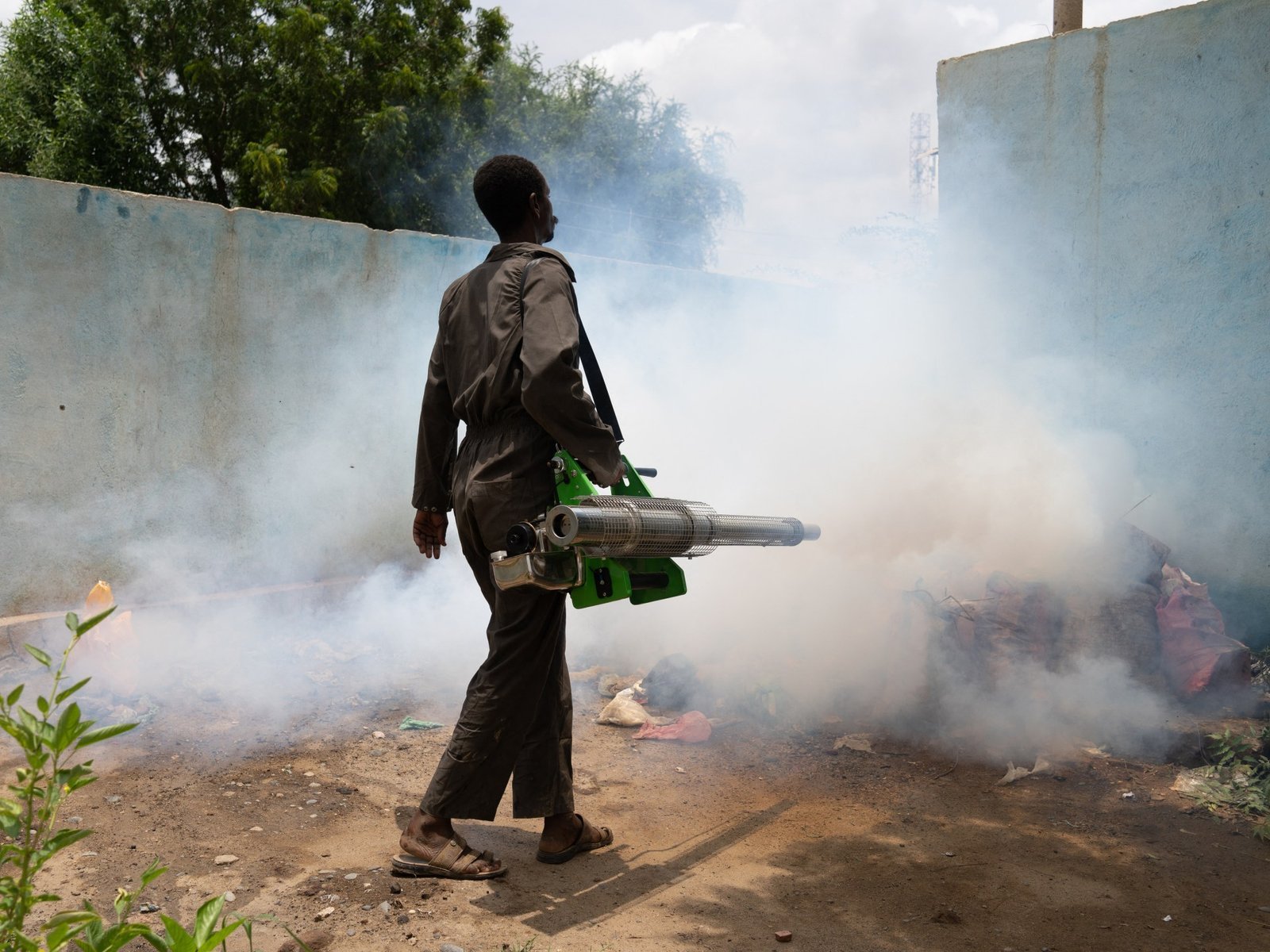
The waterborne disease has rapidly spread throughout Sudan due to the ongoing civil war.
After Sudan’s army recaptured the national capital region of Khartoum in March, tens of thousands of people returned to check on their homes and reunite with loved ones.
The joy of returning was tempered by the shock of seeing the damage caused during nearly two years under the control of the Rapid Support Forces (RSF), a paramilitary group that has been fighting the Sudanese Armed Forces (SAF), recognised by many Sudanese and the UN as the de facto authority in Sudan, since April 2023.
In a region whose hospitals and food and medicine stores had been systematically plundered by the RSF, many returnees started falling sick.
Many of the returnees had settled in Omdurman, one of the national capital’s three cities, where living conditions were slightly better than in the other cities. This is because several localities in Omdurman never came under the RSF’s control, insulating it from heavy clashes, pillaging, and looting.
Omdurman quickly became overcrowded, with “thousands of people [returning] from Egypt alone”, according to Dr Dirar Abeer, a member of Khartoum’s Emergency Response Rooms, neighbourhood committees spearheading relief efforts across the country.
The crowding, Dr Abeer said, meant an accelerated spread of cholera, an acute, highly contagious diarrhoeal infection that is endemic to Sudan and can be fatal if not treated.
“In areas south of the Nile in Omdurman, there are a lot of corpses rotting next to [or in] the Nile, and this has [partially] caused the spread of infection,” said Badawi, a volunteer in Omdurman who declined to give his full name due to the sensitivity of speaking in a warzone.
Cholera has become an epidemic in Sudan, spreading in several states, including White Nile and Gadarif, and killing hundreds in the last two weeks.
“But that’s not really possible right now,” he told media, referring to a lack of electricity to pump water since Omdurman’s electricity grids went down on May 14.
The RSF had fired a barrage of suicide drones that day, which took out major power stations and grids, consequently shutting down water treatment plants and causing a sharp rise in cases.
Deprived of safe drinking and bathing water, people have resorted to drinking contaminated water from the Nile, as well as scooping up water from the ground after it rains, Badawi said.
Omdurman falters
The SAF-backed Ministry of Health (MoH) reported a huge surge in daily cholera cases in the national capital region between May 15 and May 25, with at least 172 people dying between May 20 and May 27.
The UN says daily cases spiked from 90 to more than 815 in the latter half of May.
“We do not have enough medication or medical tools, and the rate of people coming to the hospitals is far more than we can handle,” said Kareem al-Noor, a medic at al-Nao hospital in Omdurman.
“The [remaining hospitals] are at full capacity and people are also waiting for treatment, crowded on the streets,” al-Noor added.
Dr Abeer feels the SAF-backed health authorities are not doing enough to tackle the epidemic. While she acknowledged that the health sector was largely destroyed by the RSF, she believes the current health authorities could be doing more.
media submitted written questions to Dr Montasser Towarra, the MoH spokesperson, asking him what measures the ministry is undertaking to help volunteers and to provide basic provisions.
He had not answered by the time of publication.
Sudan is also suffering an acute hunger crisis.
Since the civil war, millions of Sudanese have struggled to feed their families due to spoiled harvests, the systematic looting of markets and food aid and the destruction of homes and livelihoods.
According to the UN, about 25 million people – more than half the population – currently suffer extreme food shortages.
Hunger can weaken bodies and lead to an acute increase in contagious diseases, according to Alex De Waal, an expert on Sudan and famine.
He noted that civilians – especially children – have always been more likely to die from diseases if they are also on the brink of starvation.
“We could see an excess of hundreds of thousands of deaths [due to these factors] over the next year,” warned De Waal.

