

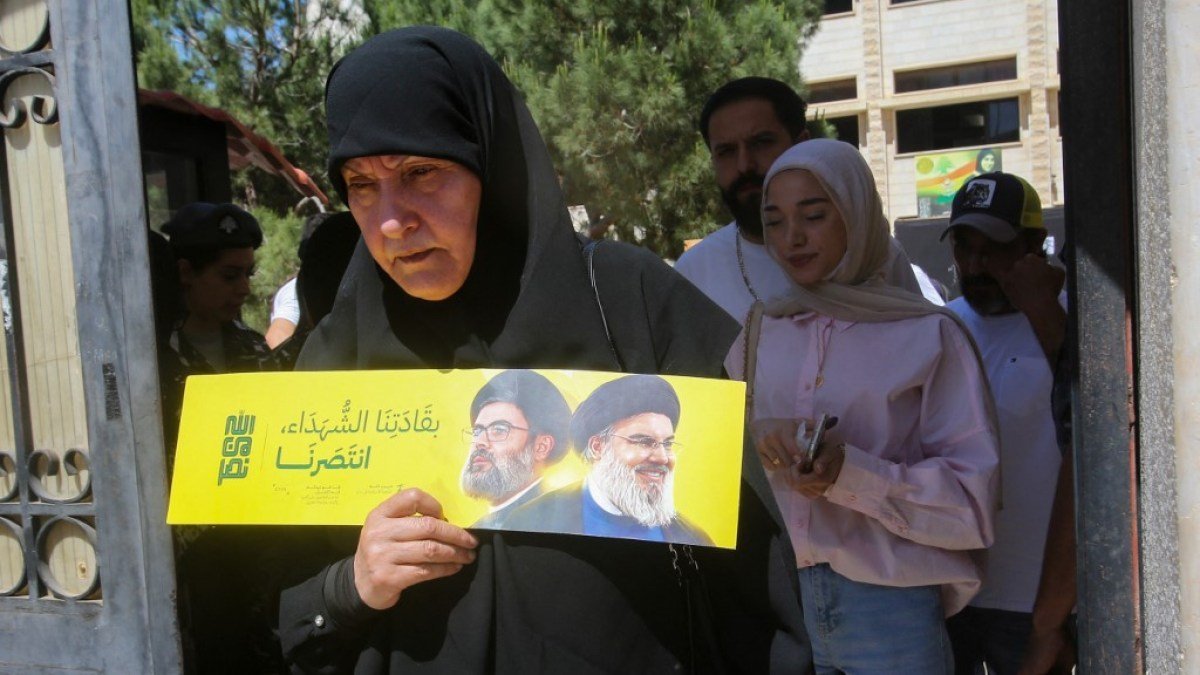
Establishment parties, including Hezbollah, emerge as the biggest winners in the first municipal polls since 2016.
Beirut, Lebanon – As southern Lebanon continues to suffer from sporadic Israeli attacks despite a ceasefire signed in November between Israel and the Lebanese group Hezbollah, establishment parties have emerged as the biggest winners of municipal elections.
Voting took place over four weeks, starting in Mount Lebanon – north of the capital, Beirut – followed by the country’s northern districts, Beirut and the eastern Bekaa Valley, and concluding on Saturday in southern Lebanon.
While Hezbollah, a Shia Muslim political and armed group, suffered setbacks to its political influence and military capabilities during 14 months of war with Israel, the group’s voter base was still intact and handed it and Amal, its closest political ally, victories across dozens of municipalities.
“The Hezbollah-Amal alliance has held firm and support among the Shia base has not experienced any dramatic erosion,” Imad Salamey, a professor of political science at the Lebanese American University, told media.
Despite establishment parties winning the majority of seats across the country, candidates running on campaigns of political reform and opposition to the political establishment also made inroads in some parts of the country, even winning seats in municipalities in southern Lebanon, where Hezbollah historically has enjoyed strong support.
In Lebanon, there is no unified bloc of reformists although political actors and groups that emerged during the 2019 antigovernment protests over the economic crisis are referred to locally as “el-tagheyereen”, or change makers.
“Alternative Shia candidates in some localities were able to run without facing significant intimidation, signalling a limited but growing space for dissent within the community,” Salamey said.
Critics, however, argued the elections favoured established parties because the uncertainty over when they would be held meant candidates waited to build their campaigns. As recently as March, there were still proposals to delay the elections until September to give candidates a chance to prepare their platforms after Lebanon suffered through the war and a two-month intensification by Israel from September to November, which left the country needing $11bn for recovery and reconstruction, according to the World Bank.
The war left Hezbollah politically and militarily battered after Israel killed much of its leadership, including longtime Secretary-General Hassan Nasrallah and his successor Hachem Safieddine.
The war reordered the power balance in Lebanon, diminishing Hezbollah’s influence. Many villages in southern Lebanon are still inaccessible, and Israel continues to occupy five points of Lebanese territory that it has refused to withdraw from after the ceasefire. It also continues to attack other parts of the south, where it claims Hezbollah still has weapons.
With their villages still destroyed or too dangerous to access, many southerners cast ballots in Nabatieh or Tyre, an act that recalls the 18-year Israeli occupation of southern Lebanon that ended in 2000. During the occupation, elections for southern regions under Israeli control were also held in other cities still under Lebanese sovereignty.
Hezbollah has given up the majority of its sites in the south to the Lebanese army, a senior western diplomat told media and local media has reported.
Hezbollah remains ‘strong’
The recent post-war period also brought to power a new president, army commander Joseph Aoun, and the reform camp’s choice for prime minister, Salam, former president of the International Court of Justice in The Hague.
Voter turnout was lower in almost every part of the country compared with 2016, the last time municipal elections took place. The places it fell included southern Lebanon, where 37 percent of the population voted. In 2016, 48 percent of its voters cast ballots. This was also true in most of the Bekaa Valley, an area that also was hit hard during the war and where Hezbollah tends to be the most popular party. In the north, voter turnout dropped from 45 percent in 2016 to 39 percent in 2025. In Beirut, the turnout was marginally higher – 21 percent in 2025 compared with 20 percent in 2016.
Many people in southern Lebanon are still living through the war as Israel continues to carry out attacks on areas like Nabatieh. While some in and from the south have questioned Hezbollah’s standing and decision to enter into a war with Israel on behalf of Gaza when they fired rockets on the Israeli-occupied Shebaa Farms territory on October 8, 2023, others still cling to their fervent support for the group.
“The municipal elections confirmed that Hezbollah and the Amal Movement remain strong,” Qassem Kassir, a journalist and political analyst believed to be close to Hezbollah, told media. “The forces of change are weak, and their role has declined. The party [Hezbollah] maintains its relationship with the people.”
Although reform forces did win some seats, including in Lebanon’s third largest city, Sidon, they were largely at a disadvantage due to a lack of name familiarity, the short campaign time and misinformation circulated by politically affiliated media.
Claims of corruption and contested election results marred voting in parts of the north, where many candidates from traditional political parties dominated.
In Beirut, forces for change were dealt a heavy blow. After receiving about 40 percent of the vote in 2016, which still was not enough to earn them a municipal seat, the reformist Beirut Madinati (Beirut My City) list won less than 10 percent of this year’s vote.
The defeat took place despite the worsening living conditions in the capital, which critics blamed on establishment parties, including those running the municipality.
“The municipality lives on another planet, completely detached from the concerns of the people,” Sarah Mahmoud, a Beirut Madinati candidate, told media on May 18 on the streets of Beirut as people went out to vote.
Since an economic crisis took hold in 2019, electricity cuts have become more common, and diesel generators have plugged the gap. These generators contribute to air pollution, which has been linked to cardiovascular and respiratory ailments in Beirut and carries cancer risks.
Despite the criticisms and degraded living situation in the city, a list of candidates backed by establishment figures and major parties, including Hezbollah and Amal, but also their major ideological opponents, including the Lebanese Forces and the right-wing Kataeb Party, won 23 out of 24 seats.
This list ran on a platform that stoked fears of sectarian disenfranchisement and promised sectarian parity.

