

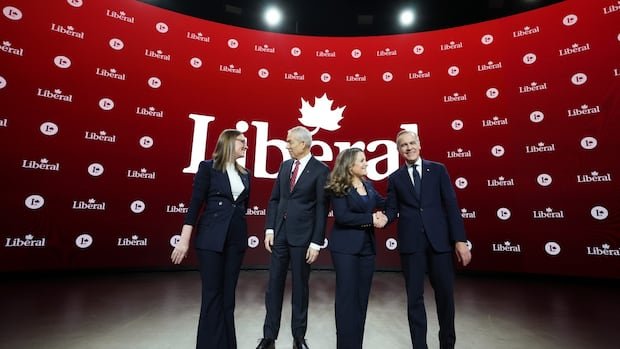
The four Liberal leadership contenders are squaring off in the first and only English-language debate in this short race to replace Prime Minister Justin Trudeau.
With Canada staring down the prospect of devastating U.S. tariffs and unprecedented threats to its sovereignty, the first half of the debate was consumed by talk of what the country should do to fight back against an increasingly belligerent President Donald Trump.
The contenders largely agreed with one another on the prescription to Canada’s current problems: hit back at Trump with dollar-for-dollar retaliatory tariffs if he starts a trade war to try and get him to back down, build up the Canadian economy and strengthen the military by spending more on defence faster than the government’s existing plan.
The candidates largely avoided directly criticizing one another and directed most of their criticisms at the man who is expected to be their main opponent in the upcoming federal election: Conservative Leader Pierre Poilievre.
Liberal leadership candidates Frank Baylis, Mark Carney, Chrystia Freeland and Karina Gould weigh in on what is motivating U.S. President Donald Trump’s threats against Canada.
Former Bank of Canada governor Mark Carney said he helped lead Canada through the Great Recession of 2008-09 and he’s prepared to steer the country through another economic crisis that could come if Trump moves ahead with a 25 per cent tariff as promised.
“You need experience in terms of crisis management, you need negotiation skills but you also need economic expertise,” Carney said. “This is a crisis.”
Carney said Canada can’t control what Trump does but it can control how it manages its own economy and he’s promising to boost economic output after years of sluggish growth under the current Liberal government, a thinly veiled swipe at Freeland, who also served as finance minister.
“Canadians have been telling me they want change — I can bring that change,” he said.
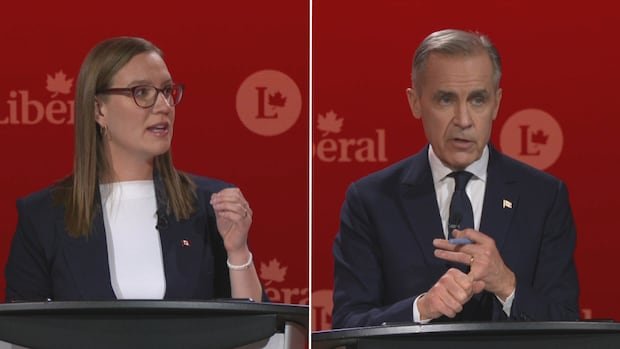
Liberal leadership candidate Karina Gould says the time to reach the NATO spending target is now. Gould pointed to previous comments by fellow candidate Mark Carney that he aims to reach the two per cent defence spending benchmark by 2030.
Carney warned it’s not just an economic fight — he said he will get Canada on a better footing to push back against Trump’s talk of making the country the 51st state.
“We will never be part of the United States in any shape or form,” he said, while promising to boost military spending to the two per cent of gross domestic product NATO target.
His commitment to get to that higher military spending “by 2030” was a point of contention because two of the other candidates, former deputy prime minister Chrystia Freeland and former government House leader Karina Gould, are promising to do it faster than that.
“It’s time for us to step up at home,” Freeland said.
“It’s not just about pushing money out the door,” Carney said when put on the defensive.
Freeland said she’s running now because “Trump is posing the gravest challenge our country has faced since the Second World War. He’s threatening us with economic warfare.”
She said she’s best placed to take on Trump because she went toe-to-toe with him in his first term, got a renegotiated NAFTA deal done and can do it again this time.
She said she will inflict economic pain on U.S. companies and Trump’s allies with retaliatory tariffs to force him to back down from this promised trade war.
Freeland said she wants to immediately convene a summit with other countries Trump has targeted in recent weeks, bringing together Mexico, Panama, Denmark (which controls Greenland) and the European Union to plot a plan to stop Trump’s trade aggression and sovereignty taunts.
Freeland said Poilievre can’t be trusted to handle the Trump threat.
Saying she has a message for Trump, Freeland looked into the camera as if speaking directly to the president: “Pierre Poilievre wants to imitate you but we’re going to defeat you.”
“Who’s the worst person to stand up to Mr. Trump? Pierre Poilievre,” Carney added. “He worships the man, he uses his language, he’s not the right person to lead our country at this crucial time.”
Carney said Canada can’t take on Trump if its own economy is hobbled by persistent internal trade barriers — a tangle of federal and provincial red tape that makes it difficult to move goods and workers across borders.
“If we have one Canadian economy instead of 13 economies, that more than outweighs the impact of what Trump’s trying to do to us,” Carney said, referencing research that shows dismantling internal trade barriers could be a big shot in the arm to the economy.
Freeland agreed with the push to do away with decades-old barriers that have held back Canada’s economic potential, calling Trump’s threats a “golden opportunity” to make big, transformative moves.
Carney said he wants to get the federal government’s fiscal house in order after big-ticket spending and big growth in the size of the public service in recent years on Trudeau’s watch.
Freeland bristled at any suggestion that the government’s fiscal track record has been poor, saying she didn’t want to see Conservative talking points about spending repeated at a Liberal debate.
To tackle persistent affordability issues, Carney said he will push through a middle-class tax cut to reduce the tax burden.
Gould said Carney’s plan to do away with the carbon tax, which hikes taxes on fuels but rebates the money collected on a quarterly basis, will actually take money out of working people’s pockets.
Low-income and no-income people are better off with a carbon tax than Carney’s middle-class tax cut, she said.
“The math doesn’t add up,” Gould told Carney.
Carney said his plan to turbocharge the economy will also help because he wants more people to have better paying jobs, again suggesting the outgoing government’s recent track record has been disappointing.
“What’s happened in this economy over the last five years? People’s wages haven’t kept pace with the rising prices,” he said.
He said now’s the time for young people to take up a trade because he wants to unleash a major infrastructure program that builds “projects of national interest” that will require skilled workers.
While lamenting slow growth, Carney said he wants to keep new programs like child care, pharmacare and dental care in place, accusing Poilievre of wanting to dismantle these signature Liberal initiatives that he said make life more affordable for people who need the help most.
Later in the debate, talk turned to how to bring young Canadians back into the Liberal fold given polls show some of those voters are turning to other parties.
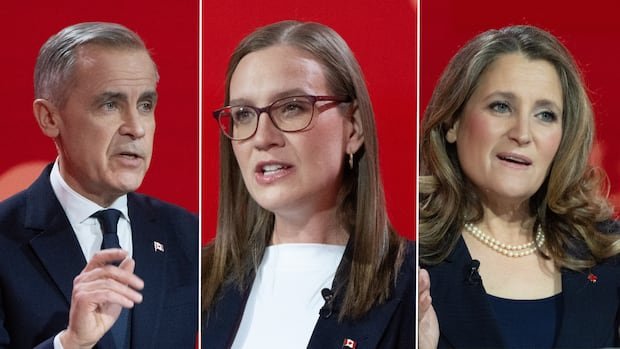
Liberal leadership candidate Karina Gould says the Liberal Party lost the trust of young people because they ‘weren’t focused on the issues that mattered to them.’ Fellow candidates Chrystia Freeland and Mark Carney also weigh in on how to connect with younger Canadians.
Gould said the party has lost touch with young people and the solution isn’t to become “Conservative lite.”
She said the party needs to be proudly progressive with an ambitious plan to get more homes built through government support and tackle climate change.
Carney said the country isn’t doing nearly enough to build homes and a generation of Canadians feel locked out of a path to prosperity.
He said he wants to double housing starts to roughly 500,000 a year to get many more people into homes they can afford.
Like Freeland, he’s pitching a plan to remove the GST for first-time homebuyers, which will make properties more affordable.
The four candidates vying to replace Prime Minister Justin Trudeau are debating for a final time as the Liberal leadership contest enters the home stretch.
The candidates will be discussing four main themes: Canada’s place in the world, growing the economy, affordability, housing, the environment and public safety and health care.
-
You can watch CBC News’s special coverage of Liberal leadership candidates’ English-language debate on CBC News Network, CBC.ca and CBC Gem starting at 7:45 p.m. ET. CBC’s Rosemary Barton and David Cochrane provide analysis and cover the post-debate scrums.
Tuesday’s showdown comes on the heels of Monday’s French-language debate. Canada-U.S. relations was a main topic of discussion during that debate, with the four candidates pitching themselves as the best person to handle U.S. President Donald Trump.
The French debate was cordial overall with the candidates saying multiple times that they agree with one another.
The party disqualified a fifth would-be candidate, Ruby Dhalla, on Friday for violating the race’s rules.
Former CBC News host Hannah Thibedeau is moderating Tuesday’s debate. The Liberals will announce their new leader on March 9.

