

Less than a week after U.S. President Donald Trump abruptly announced another high-profile summit with Russian President Vladimir Putin, this time in Budapest, Hungary, the plans were quickly shelved — with the White House later announcing sanctions against two Russian oil companies.
It was the latest swing by Trump, who has repeatedly changed his position and approach to the war in Ukraine, which began in February 2022, when the country was invaded by Russia.
After he was praised by many for helping to cement a ceasefire in Gaza, Trump was likely keen to see if some of that peacemaker momentum could carry over into a conflict he once vowed to end within 24 hours.
But with Russia unwilling to compromise and give up some of its ambitions around Ukraine, the conversation has once again shifted back toward how Kyiv and its allies can dial up the pressure on Russia both on and off the battlefield.
“I do believe Trump is hopeful that whatever means necessary, he will just bring Putin to the table,” said Oleksandr Kraiev, director of the North America program at Ukrainian Prism, a Kyiv-based think-tank. “The problem with that is unfortunately the United States is quite inconsistent.”
On Wednesday, after meeting with NATO Secretary General Mark Rutte, Trump said he didn’t feel that meeting with Putin would be right and that he hoped sanctions levied on Russian oil companies Rosneft and Lukoil won’t last long.
“Given President Putin’s refusal to end this senseless war, Treasury is sanctioning Russia’s two largest oil companies that fund the Kremlin’s war machine,” U.S. Treasury Secretary Scott Bessent said in a statement. “We encourage our allies to join us in and adhere to these sanctions.”
Summit shelved
Even though Moscow wants more Ukrainian land and a weakened Ukrainian military, it is still trying to appear as though it is a willing participant in negotiations to bring the war to an end.
Sergei Ryabkov, Russia’s deputy foreign minister, said preparations for the Budapest summit were still underway, and he went on to chastise what he called rumours circulating in Western media.
Despite the diplomatic discrepancy, the Washington-led negotiations appear to be at a standstill, even as Russia continues to launch deadly attacks against Ukrainian cities and Kyiv ramps up attacks on Russia’s energy sector.
Kyiv said it hit a chemical plant in Bryansk, in western Russia, overnight with a long-range U.K.-made Storm shadow missile. Hours later, Russia announced that it is going to be using reservists to protect infrastructure because of a sharp rise in Ukrainian strikes.
The attacks, which have reportedly been carried out with the help of U.S. intelligence, have led to gas shortages and a rise in prices in a number of regions. They’re forcing Russia to reconsider security far from the front lines, but they’re not yet enough to force it to the negotiating table.
Trump’s idea for a Budapest summit collapsed amid reports that Russia had once again rejected calls for a ceasefire along the current front line, demanding that it take full control of Ukraine’s Donbas region, which is an industrial hub with vast coal deposits.
The U.S. president told reporters he didn’t want to hold a meeting with Putin if it would be a waste of time.
Hours before Washington said the meeting wasn’t going ahead, 10 European leaders, along with British Prime Minister Keir Starmer, signed a letter calling out Russia’s “stalling tactics” and appealing for pressure to be ramped up on Russia’s economy and defence industry.
The push for more fighter jets
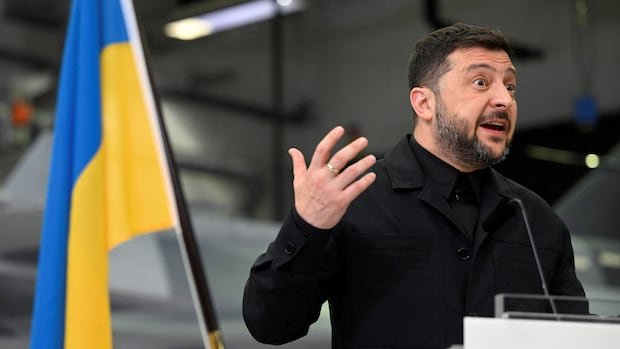
On Wednesday, after more than 400 Russian drones and missiles were fired at Ukraine, killing at least seven and damaging energy infrastructure, Zelenskyy was in Scandinavia once again making an appeal to his European counterparts.
“Russian words about diplomacy mean nothing as long as the Russian leadership does not feel critical problems, “ Zelenskyy wrote on the social media platform X. “This can be ensured only through sanctions, long-range capabilities, and coordinated diplomacy among all our partners.”
Sweden and Ukraine signed a letter of intent which could see Kyiv buy up to 150 Gripen fighter jets made by Swedish manufacturer Saab AB.
On Friday, Zelenskyy is expected to attend a meeting of allies, dubbed the “coalition of the willing,” in London.
“The main goal for Ukrainians, and I hope the main goal for the Americans, is just to push Russia to the brink of its economic and military capabilities,” Kraiev, of Ukrainian Prism, said. “Destroying this all to the point when Russia is no longer able to wage a full-fledged war.”
Targeting Russian energy sites
In recent months, Ukraine has dramatically stepped up its strikes on Russian refineries and other energy infrastructure, using Ukrainian-made drones in many cases.
An analysis conducted by BBC Verify found that 21 of Russia’s 38 major refineries have been struck since January.
According to data compiled by U.K.-based non-profit group Open Source Centre, there were more than 90 strikes on Russian energy infrastructure between Aug. 2 and Oct. 14 this year.

On Wednesday, Russian Vice-Admiral Vladimir Tsimlyansky, deputy head of the General Staff’s main organizational and mobilization directorate, said there is now an increased threat to Russia’s critical infrastructure and residential areas because of Ukraine’s long-range drone strikes.
As a result, he said, reservists will be used to help protect these facilities deep in Russia.
“The Ukrainians are breaking through,” said Vladimir Milov, a Russian opposition politician and energy expert living in exile.
“If Ukrainians keep hitting in the coming weeks and months, that might exacerbate an already very serious crisis.”
Rise in gas prices
Milov, who previously worked with the Russian government and briefly served as the deputy energy minister in 2002, told CBC News that it is difficult to gauge exactly how the strikes have impacted Russia’s refining capacity because since last year, the data has been classified.
“All of the technical details about the extent are not known. What we do know … is that the pressure on the domestic gasoline market has greatly increased,” he said.
“The wholesale and retail prices for gasoline in Russia have been skyrocketing in recent weeks.”

Milov said while the high prices have contributed to consumer grumbling, they haven’t led to larger problems, at least for now.
“The consistency and breadth of strikes matters,” he said. “When they affect a large number of refineries … Russia is no longer capable of swiftly coping with it, quickly repairing that stuff.”

