

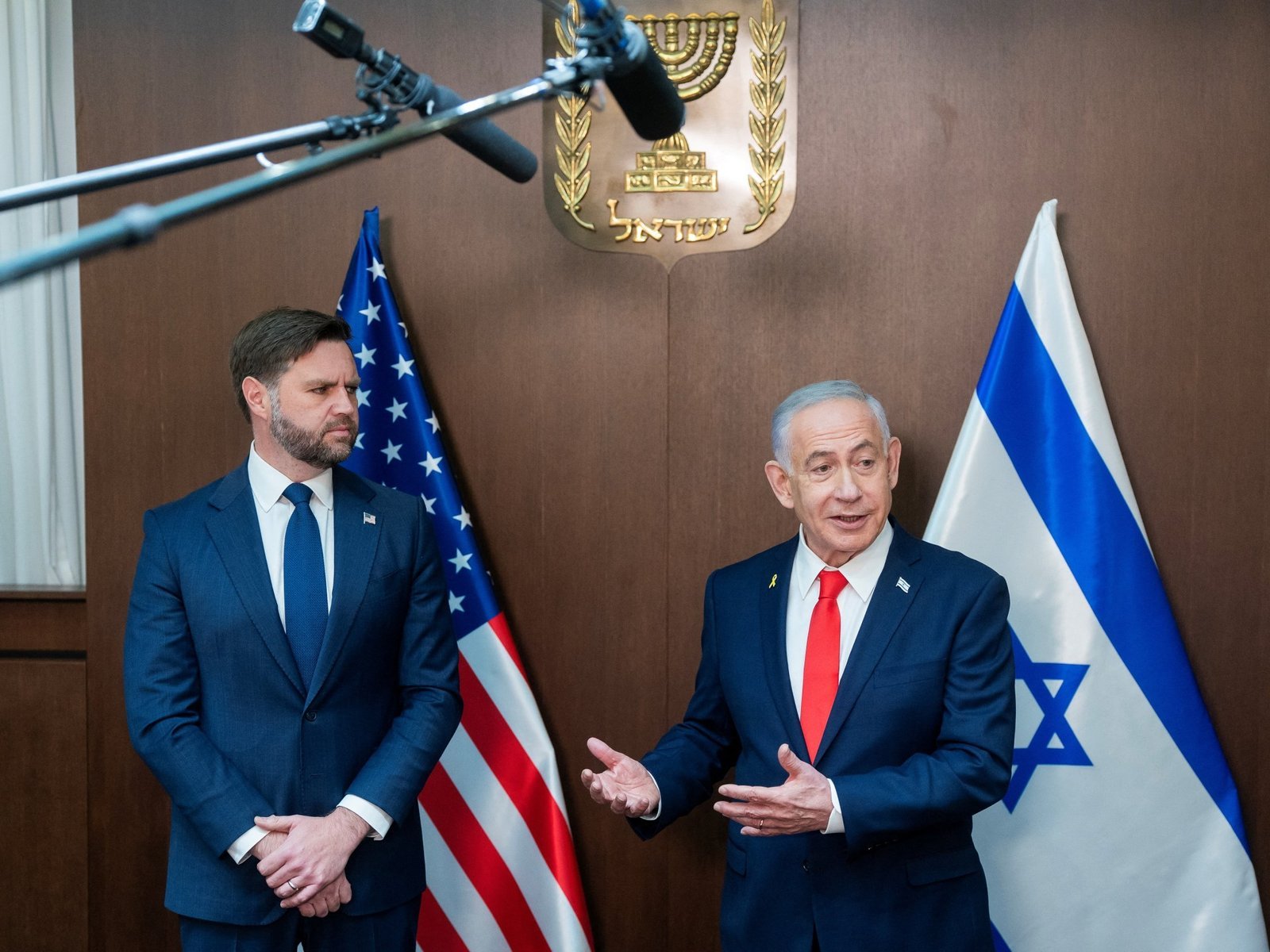
The US and Israel have long been close allies, but is Washington now emphasising its dominance?
A succession of high-ranking US officials have found themselves in Israel in recent days – first special envoy Steve Witkoff and presidential adviser Jared Kushner on Monday, then Vice President JD Vance on Tuesday, and Secretary of State Marco Rubio on Thursday.
Their focus has been clear – to stop the US-backed Gaza ceasefire deal from collapsing. And that essentially means ensuring that the Israeli government of Prime Minister Benjamin Netanyahu does not back out of the agreement, which ended two years of war earlier this month.
The presence of the US officials in Israel has been described as “babysitting” – designed to twist the arm of a far-right government itching to find any excuse to relaunch the war, which killed more than 68,000 Palestinians.
And so far, the administration of US President Donald Trump appears to have largely succeeded, highlighting what some analysts deem to be Israeli subservience to the US, and an acknowledgment that when Washington orders Israel to do something, the latter will ultimately agree.
“Of course, Israel is a client state of the US,” Alon Pinkas, a former Israeli ambassador and consul general in New York, told media. Pinkas referred to the billions of dollars Israel receives from the US in aid, the dozens of times Washington uses its veto to protect Israel from criticism or sanction at the United Nations, and its military protection of Israel.
Now the Trump administration is leveraging that support and doing what is a rare occurrence when it comes to relations between the two countries: forcing Israel to act according to the US’s wishes, and making public Washington’s pressure on Israel.
Netanyahu understood the message, and his office called the vote a “political provocation” – even as members of his own government voted in favour, and even though he himself has previously backed annexation.
The US has always been the stronger party in the relationship with Israel. It is the global superpower, while Israel is an ally with a traditionally large constituency of support within the US.
But US governments, for whatever reason, have often tried to avoid any direct confrontation with Israel. Former US President Joe Biden adopted a “bear hug” policy towards Israel during the first three months of the war on Gaza, arguing that the Israelis needed to be publicly backed in order to convince them to avoid going too far in their destruction of the Palestinian enclave.
That did not work, with Netanyahu repeatedly ignoring attempts to get him to agree to a ceasefire. Instead, it was Trump, who is incredibly popular in Israel for the support he gave the country in his first term, who has taken the relatively more confrontational route with Israel since his return to the presidency. So far, it appears to be working.
“Benjamin Netanyahu has been put on notice,” Yossi Mekelberg, a senior consulting fellow at Chatham House, told media. “The US team can say all these different things – as they are doing – but it’s pretty obvious what their agenda is.
An unequal partnership
“Look at the 60 Minutes interview [US presidential adviser Jared] Kushner and [US special envoy Steve] Witkoff gave where they spoke of betrayal and a loss of control. To my mind, this contradicts all the shows of friendliness we’re seeing in the Israeli press. This is the Trump administration coming over and saying quite clearly: ‘You do as you’re told.’”
Mekelberg was referring to an interview aired by CBS News last week, in which Witkoff described both himself and Kushner as feeling “a little bit betrayed” by Israel’s decision to strike at the Hamas negotiating team in Doha, Qatar in September. Continuing, Kushner emphasised how Trump, his father-in-law, had felt the Israelis “were getting a little bit out of control in what they were doing, and that it was time to be very strong and stop them from doing things that he felt were not in their long-term interests”.
“And what’s more – as we’re seeing from both US business, as well as the Trump family business, who are heavily invested in the region – stability and peace are profitable for all.”
“It’s true that Israel’s lost some of its independence in this, but there’s nothing new in that,” Barak added. “I think that’s what we’re seeing right now in the way the US is managing the ceasefire. It’s a combination of carrot and stick and right now, with Vance and the others over, is a reminder of the stick.”
And as for the carrot, Trump can focus on what he believes Netanyahu wants – political success, and an end to the prime minister’s legal troubles.
Speaking at the Knesset to mark the ceasefire in early October, Trump called upon Israel’s President Isaac Herzog to pardon Netanyahu in the multiple corruption cases he has faced since 2019.
“Trump can do that,” Mekelberg said. “He can say to Netanyahu, look, I’ll come over. I’ll talk to the Knesset, I can even ask for you to be pardoned, but in return, you follow the script.”
Suggestions that Israel has lost much of its independence in its dealings with the US have appeared to rankle Netanyahu.
‘‘I want to put it very clearly. One week, they say that Israel controls the United States. A week later, they say the United States controls Israel. This is hogwash,” said the prime minister, in response to a question about Israel being beholden to the US.
Irrespective of Netanyahu’s protestations about US control of Israel, much of the evidence contradicts him. In addition to the current US diplomatic blitz, intended to ensure that Netanyahu carries through with the ceasefire, there are other instances of the Trump administration determining Israeli policy.
The ceasefire itself was announced during Netanyahu’s last visit to Washington, seen as a tactic by some observers intended to have the prime minister commit to its terms publicly before returning to Israel.

