

One day after U.S. President Donald Trump’s bold proclamation of a “historic dawn of a new Middle East,” the much-vaunted ceasefire deal came under strain as Israel and Hamas accused each other of violating the fragile agreement, even as world leaders rushed to work out the next steps to try and preserve it.
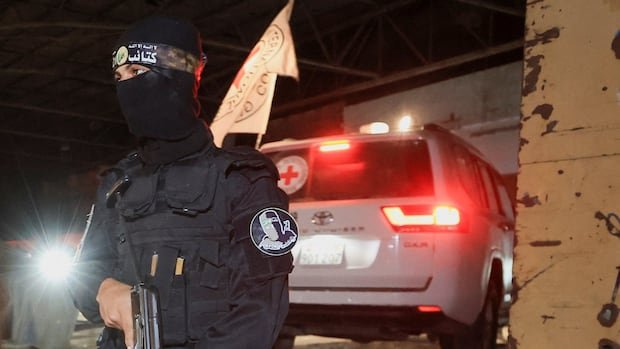
Phase 1 of the peace plan was about stopping the fighting, ramping up aid and returning all the Israeli hostages in Gaza in exchange for Palestinians imprisoned or detained in Israel.
By Tuesday, there was friction on all of those points. Meanwhile in Gaza, deadly clashes have erupted as Hamas seeks to secure its authority, including through the execution of those it accuses of collaborating with Israel.
“We’re in a deep crisis mode,” said Gershon Baskin, a veteran Israeli negotiator in an interview with BBC News.
“There’s a lot of work to do, and we can’t allow this agreement to collapse so soon. It can’t be allowed to collapse at all.”
Nimrod Novik, a former adviser to late Israeli prime minister Shimon Peres, fears there’s a chance the Gaza ceasefire could derail amid escalating distrust.
Recovering the deceased hostages
After Hamas only returned four of the 28 bodies of the deceased hostages still in Gaza, Israel announced that it would not reopen the Rafah crossing between Egypt and Gaza, and would only allow half of the agreed-upon 600 aid trucks into the territory.
Hamas then returned four more bodies on Tuesday night.
Even before the agreement came into effect, the militant group signalled that it would take time to find all of the remains, because of the vast ruins in Gaza where around 60 per cent of the buildings have been destroyed or damaged, according to researchers from Oregon State University.

But on Tuesday, the Israeli government decided to curtail desperately needed aid, saying that Hamas had violated the agreement.
“We can control how many trucks are going inside the Gaza Strip a day. We have things we can do, and I think we can and we need to,” said Ela Haimi, whose husband Tal Haimi was killed while defending the Nir Yitzhak kibbutz. He was one of around 1,200 people killed in Israel during the Hamas-led Oct. 7, 2023 attack; his body was later taken back to Gaza.

Haimi, who was at the time two months pregnant with their fourth child, fears that her husband’s body may never be returned and her family won’t be able to properly bury him.
“I have hopes for my country and my government that they will press Hamas with the help of the international community,” she said in a Zoom call with journalists Tuesday night.
She says she doesn’t want the process to move onto the next stage until all of the bodies are returned, but on Monday in Egypt, Trump declared that the second phase had already begun.
Power vacuum
The next stage requires Israel to withdraw further from Gaza and for Hamas to give up its weapons. This will almost certainly prove challenging, given that the militant group is still exerting its authority over the portion of Gaza from which Israel has withdrawn.
Armed men wearing masks have been filmed patrolling the streets, and on Monday, a video surfaced on social media of Hamas fighters carrying out public executions of individuals accused of collaborating with Israel.
Several have also been killed in clashes between Hamas and local gangs.

Under the agreement, a temporary international stabilization force will be deployed to Gaza, but there are few public details around which countries would send forces.
Nimrod Novik, a fellow with the Israel Policy Forum and an adviser to former Israeli prime minister Shimon Peres, has been involved in diplomatic discussions around what potential agreement might look like.
He says plans developed under former U.S. secretary of state Antony Blinken call for a force of around 35,000 to provide security and maintain order. Deploying that many troops will take time.

“I worry that until Phase 2 kicks in, the interim uncertainty is a prescription for miscalculations, misunderstandings,” he said in a Zoom interview with CBC News from his home in Ra’anana, Israel.
“A small Hamas provocation responded to by an over-disproportionate Israeli response, and before you know it things can spiral out of control.”
On Tuesday, the Gaza Health Ministry reported that seven Palestinians were killed in Israeli fire, including five who were killed while trying to check on their houses near Gaza City.
The Israel Defence Forces said they fired on individuals who had crossed the yellow demarcation line to which troops had withdrawn and were approaching them.
Novik said that if the agreement stagnates and the IDF and Hamas each remain in control over separate halves of Gaza, the friction between them could “derail the entire process.”
He says what gives him some optimism is that the U.S. has deployed 200 troops to monitor and help support the ceasefire from Israel.
More than 67,000 have been killed in Gaza since Oct. 7, 2023, according to local health officials. The bombardment decimated most of the local infrastructure, schools and hospitals, which now all will need to be rebuilt.

Who will govern Gaza?
On Tuesday, an official with the United Nations Development Programme said that European and Arab nations along with the U.S and Canada had committed to $70 billion US in funding to help rebuild Gaza.
While that process will take several years, there are immediate questions on just who will govern it.
Trump’s original plan called for a “board of peace” that would oversee local governance. He originally spoke about appointing former U.K. prime minister Tony Blair to the board and chairing it himself, but in recent days has been less clear about who would be on it.

“This looks like another colonization, ignoring what the Palestinians themselves want,” said Hiba Husseini in an interview with BBC News.
Husseini, a lawyer based in Ramallah in the West Bank, has previously worked as a legal adviser to Palestinian delegations in negotiations with Israel. She says the vague agreement is riddled with shortcomings.
“Most importantly, the Palestinian Authority, the [Palestine Liberation Organization], were not involved in negotiating any part of it,” she said, referring to the two organizations that represent Palestinians in the occupied territories, and more broadly, as an umbrella group.
“Going forward is going to be very, very challenging.”

