

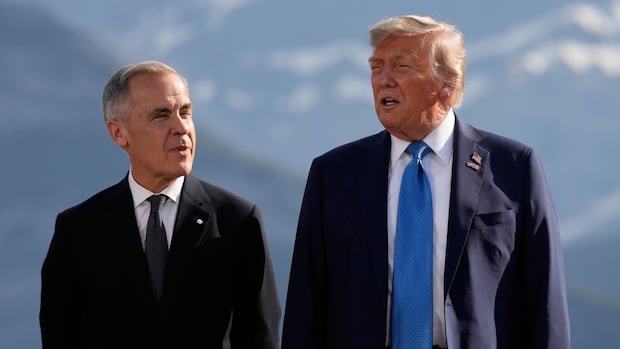
Prime Minister Mark Carney will sit down with his U.S. counterpart at the White House Tuesday for their second Oval Office meeting in less than six months as the American trade war continues.
The Prime Minister’s Office has billed this meeting as a chance for the two sides to discuss “preparation for the first joint review” of the Canada-U.S.-Mexico Agreement (CUSMA) that is scheduled to start next year.
But this is also a crucial opportunity for Carney to lobby Trump to get some tariff relief as U.S. levies hammer critical sectors like steel, aluminum, autos and lumber.
“We have work to do with our American partners on sectoral tariffs,” Canada-U.S. Trade Minister Dominic LeBlanc said in question period Monday. “That’s exactly the conversation the prime minister will have with the president.”
There is optimism around Prime Minister Mark Carney’s latest meeting U.S. President Donald Trump in Washington about movement on steel and aluminum tariffs. But even if there is a breakthrough, tariffs on Canadian lumber have become a new concern.
Government sources speaking to CBC News and Radio-Canada say they are cautiously optimistic the prime minister can broker some relief on steel tariffs — although nothing is certain.
While Carney has made a series of concessions — dropping some retaliatory tariffs, pausing the digital services tax and ramping up border protection and defence spending — Trump has shown Canada little goodwill in return.
Laura Dawson, an expert on Canada-U.S. relations and the executive director of the Future Borders Coalition, said it’s unlikely Carney will leave D.C. empty-handed.
Pressure to deliver
She said Carney wouldn’t be going for a second White House meeting without the expectation of delivering some progress on the trade file.
“I think this is a time to be optimistic. I see motion in all the right directions,” Dawson said.
Canada is determined to get the Americans to lift some of the Section 232 tariffs on goods like steel and aluminum before the CUSMA review process begins, she said.
Rolling tariff discussions into that larger renegotiation — expected to be a drawn-out process — has the potential to prolong the economic pain.
“I think they will have something to announce, and it is going to be something that the president will be broadly supportive of, and he will be glad to have someone of Mark Carney’s stature there with him to announce whatever this is,” she said.
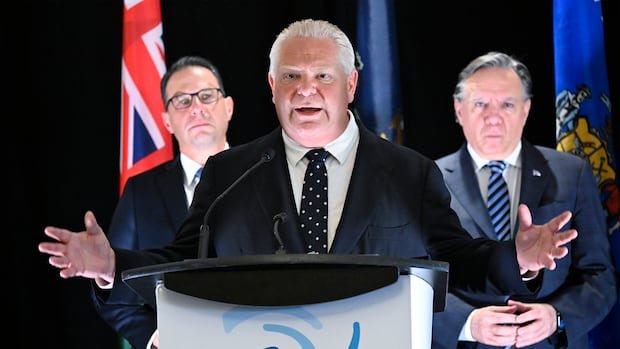
Ontario Premier Doug Ford, standing alongside Quebec Premier François Legault and several Great Lakes governors on Monday ahead of a planned meeting between the U.S. president and Canada’s prime minister, said he wants to see a fair trade deal for both sides of the border.
Speaking in the Oval Office on Monday, Trump said he expected the two leaders would speak about tariffs, adding that “a lot of companies from Canada are moving into the U.S.”
“He’s probably going to be asking about tariffs,” he said. “They’re losing a lot of companies.”
Some auto manufacturers have shifted production south of the border to avoid Trump’s tariffs, but there has not been evidence of a widespread move to the U.S. by Canadian companies.
However, the effects of Trump’s tariffs have been wide-reaching on Canada’s economy.
Ontario’s manufacturing sector has shed thousands of jobs this year. Aluminum exports are down double digits. The forestry sector has also seen job losses and stalled investment decisions.
There have also been knock-on effects in the U.S., where American businesses and, in turn, consumers are actually paying these tariffs.
Trump’s trade program has fuelled inflation south of the border while adding billions of dollars to the U.S. Treasury in what the Tax Foundation calls “the largest tax hike since 1993.”
Carney and Trump agreed over the summer to reach some sort of agreement on tariffs by August — a deadline the two sides blew past.
Since then, the tariff pressure on Canada has only intensified as the Trump administration hikes existing Section 232 tariffs and adds new ones.
Just last week, Trump announced new Section 232 levies on lumber and timber, kitchen cabinets, vanities and other furniture and upholstered products, arguing Canadian and other imports are somehow a “national security” threat.
On Monday, Trump promised new tariffs on medium- and heavy-duty truck imports, potentially adding to the vehicle assembly sector’s woes.
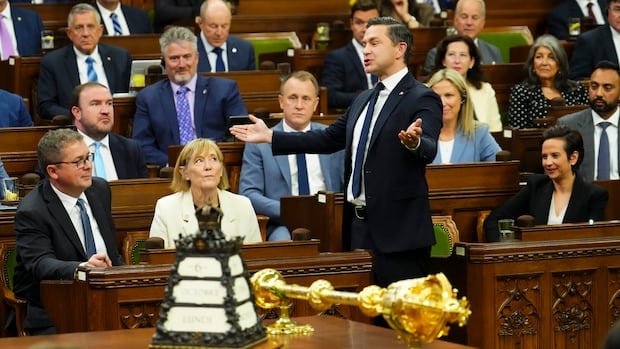
Leader of the Opposition Pierre Poilievre asked Monday during question period if Prime Minister Mark Carney will announce an end to all U.S. tariffs on Canadian goods during his D.C. trip on Tuesday.
Conservative Leader Pierre Poilievre wrote a scathing letter to the prime minister ahead of his meeting, saying Carney has been a disappointment on the trade file and needs to come back from this trip with some wins for Canada.
“If you only return with excuses, broken promises and photo ops, you will have failed our workers, our businesses and our country,” Poilievre said.
Ontario Premier Doug Ford meanwhile said he trusts Carney to fight for Canada when he comes face-to-face with the country’s top trade adversary.
“Hopefully, they can come out with a great deal, a fair trade deal for both sides of the border,” Ford said.
“I am confident the prime minister is going to go in there and do a great job. He’s a smart, smart businessperson.”

