

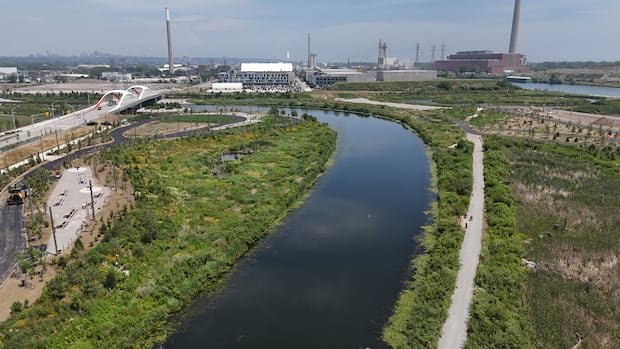
A new study of one of Canada’s most urbanized rivers suggests it dumps the equivalent of about 18 cars worth of microplastics into Lake Ontario every year, a finding that shocked the lead author and underscored efforts to cut down on pollution.
The peer-reviewed study published Thursday estimates the Don River basin flushes about 500 billion particles of microplastics, with a mass of about 36,000 kilograms, into the lake each year. That’s far more than the estimated 160 kilograms of larger plastic items.
“I was pretty shocked to see that levels that we see here are more on par with places that don’t have as good of waste management,” said co-author Chelsea Rochman, an expert on plastics pollution and associate professor at the University of Toronto.
Microplastics, no bigger than a pencil eraser and down to particles smaller than what’s visible with the human eye, have become ubiquitous and shown up everywhere from human blood to Arctic Sea ice. The broken-down bits of larger plastics have been linked to a suite of issues in wildlife, including lower levels of fish growth and reproduction, while also raising concerns about possible human health impacts.
Mismanaged waste, paint, tire dust, synthetic fibres from our clothing: these are just some of the sources of microplastics that are distributed into the air we breathe, the water we drink and the food we eat. Watch Plastic People now on CBC Gem and The Nature of Things YouTube channel.
Some common sources of microplastics in the Don River are construction foam, car tires, plastic pellets and tiny pieces shed from larger single-use plastics, Rochman said.
The most common large plastics found in the river were bags and wet wipes, accounting for about 20 per cent each, the study suggested. Rochman estimates there are tens of thousands of those wipes sitting in the river system at any given time, particularly in Taylor-Massey Creek.
For comparison, another study co-authored by Rochman and published in June found the Don River discharged far more large plastics than the river running through Chicago.
“By understanding these sources, we can work with the relevant stakeholders to turn off the tap on each of those sources,” said Rochman.
That includes working with companies to stop foam from blowing off construction sites, continued support for sewer infrastructure upgrades and banning some single-use plastics, said Rochman.
“There’s a lot we can do, but it’s really important that we monitor.”
Toronto’s sewage system part of problem
Part of the issue is Toronto’s aging combined sewer system, Rochman said.
When heavy rains stretch the system, untreated sewage is dumped into the river and Lake Ontario. When people flush plastic wet wipes down the toilet — “which we should never do,” Rochman says — they can get released into the river during a storm.
The city is in the midst of a $3-billion program to upgrade the system and get sewer overflow out of the river.
The researchers behind the study measured plastics before, during and after a storm at four spots along the river basin. The study suggests the amount of plastic in the river was about the same before and after the storm.

That finding suggests if all plastic pollution was cut off the river may naturally “clean itself” over time, Rochman said.
“We could truly protect this watershed that a lot of us here in Toronto know well and love,” she said.
The study was published in the academic journal Philosophical Transactions A of the Royal Society.

