

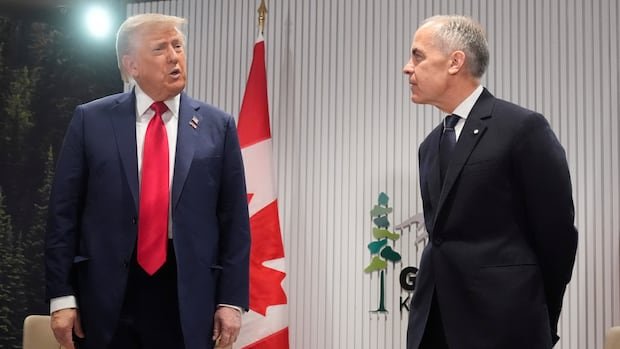
U.S. President Donald Trump sounded an optimistic tone as he met with Prime Minister Mark Carney Monday on the sidelines of the G7 summit in Kananaskis, Alta., to discuss tariffs and other trade irritants — saying he thinks the two leaders can hammer out a deal within weeks or sooner.
Speaking briefly to reporters ahead of the bilateral meeting before the wider G7 summit got underway, Trump said the “primary focus” of this meeting for him is “trade with Canada” and he’s sure the two countries “can work something out.”
While conceding he’s a “tariffs person” who likes the relative simplicity of imposing broad-based tariffs on goods from other countries to raise revenue and try to bring jobs back to the U.S., Trump said Carney has come forward with “a different concept,” and it’s one “some people like and we’re gonna see if we can get to the bottom of it today.”
“I think Mark has a more complex idea but it’s still very good,” Trump said of some sort of trade pitch Carney has made to the Americans — a proposal that hasn’t yet been made public. “I think we’re gonna accomplish a lot.”
U.S. President Donald Trump said he and Prime Minister Mark Carney have different concepts around trade. Trump reiterated his support for tariffs, saying: ‘It’s simple, it’s easy, it’s precise.’ Trump noted that Carney has ‘a more complex idea,’ and said, ‘we’re going to look at both.’
Following his rosy remarks about Carney and Canada at a White House meeting in Washington last month, Trump said he’s “developed a very good relationship” with the prime minister and he’s hopeful the two sides can work out their issues.
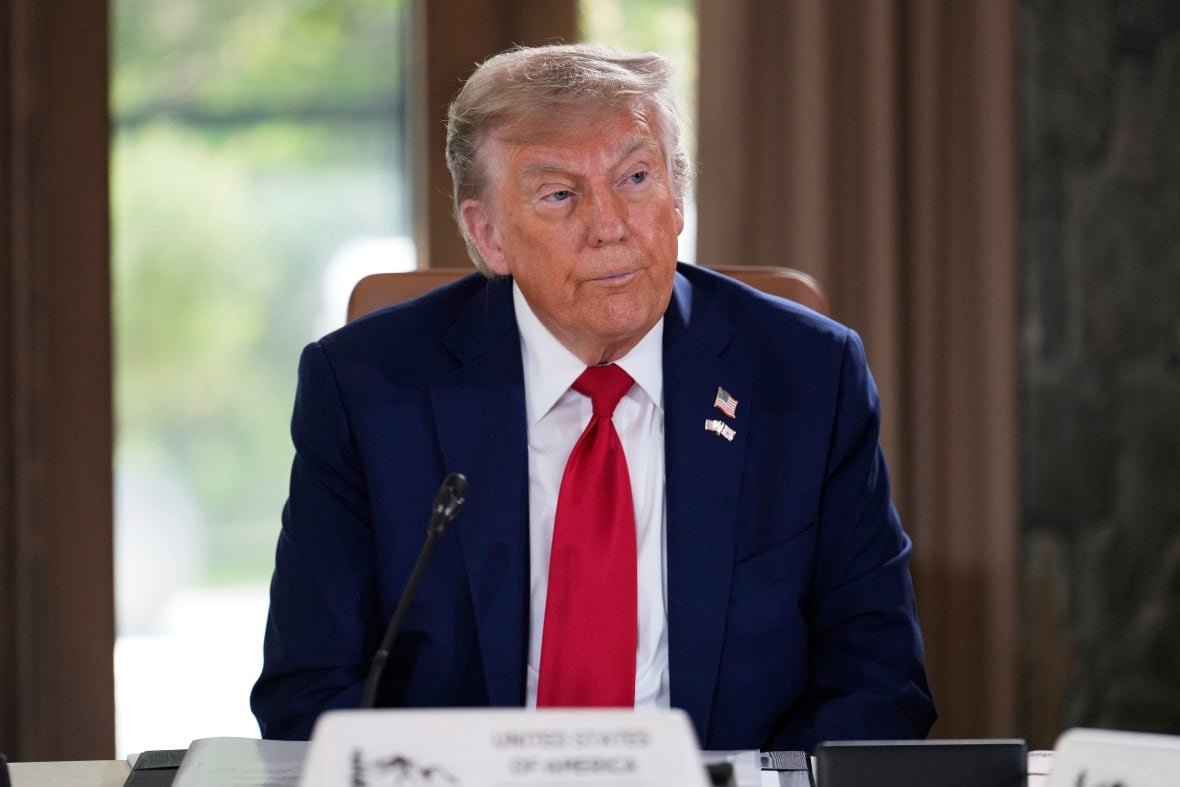
In an unusual move, Trump was wearing a second pin on his suit lapel.
Below the standard American flag pin that is ubiquitous on the chests of U.S. politicians, Trump wore a second one with the U.S. stars and stripes crossed with the Canadian flag — a friendship pin. Carney, meanwhile, wore his Order of Canada pin.
The Prime Minister’s Office told reporters at the summit that Trump’s Canada-U.S. flag pin was not a gift from the Canadian delegation and it was not included in the welcome basket provided to him and other leaders.
A senior government official, speaking on background, said the meeting was almost entirely focused on advancing the ongoing negotiations over tariffs and Carney’s promised overhaul of the bilateral trade and security relationship.
The official said Canada was particularly encouraged by “the length and tone” of the one-on-one conversation between Trump and Carney, which lasted for 30 minutes of the 70-minute meeting bilateral meeting. Other officials then joined for a broader discussion.
Asked later by reporters how the talks with Trump went, Carney simply said: “Fantastic.”
Signs of progress
CBC/Radio-Canada reported last week that Canada and the U.S. appear to be making progress toward some sort of trade agreement.
Sources with direct knowledge of the situation said a working document outlining details of a potential deal has been sent back and forth between Ottawa and Washington.
Carney is pushing hard to get Trump’s punishing tariffs on Canadian goods lifted — trade action that has already led to job losses in the steel and aluminum sectors and disruption in the auto industry.
In another sign that those discussions could be headed in the right direction, Trump brought along two of his top trade officials — Secretary of State Scott Bessent and U.S. Trade Representative Jamieson Greer — for his discussion with Carney Monday.
The presence of those two figures, who are not normally at summits like this one, suggests there could be some movement — even as Canadian officials have repeatedly urged caution about the prospect of a deal this week, given Trump is known to be unpredictable.
While friendly to Carney in his public remarks, Trump railed against former prime minister Justin Trudeau, blaming him for turning what was the G8 into the G7 by removing Russia.
But the decision to kick Russian President Vladimir Putin out wasn’t Trudeau’s — in fact it was made in 2014 before Trudeau was even prime minister. The removal came after Russia invaded Ukraine and illegally annexed part of its territory, Crimea.
Trump said it was a “very big mistake” to leave Putin out because there’s so much talk about Russia at these summits and it might have been useful to have him in the room.
But when asked if Putin should be invited now or in the future, Trump demurred.
“I’m not saying he should at this point because too much water has gone over the dam, maybe,” he said. “But Obama and the proud head of your country didn’t want him.”
As the host of this 51st G7 summit, Carney was the first to speak at the leaders’ meeting, using his time to urge his fellow heads of government to pull together at this “hinge moment” in history.
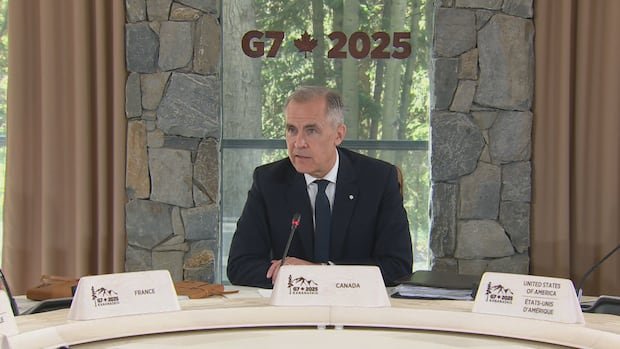
Prime Minister Mark Carney opened the G7 in Kananaskis, Alta., Monday morning, saying that the summit comes at a ‘turning point in history’ where the world looks to the G7 for leadership. This first meeting starts two days of discussions between world leaders.
Just like how past G7 leaders came together to deal with the economic and oil price shocks of the 1970s, the fall of the Soviet Union and the Iron Curtain in the 1990s and Islamic terrorism in the early 2000s, Carney said the most powerful democracies can pull together to take on an increasingly “dividend and dangerous” world.
“We all know there can be no security without prosperity and no prosperity without resilience. In a world where shocks flow across the borders, resilience comes from co-operation, co-operation that starts around this table,” Carney said.
Carney said he’s expecting some “frank discussions” over the next two days — an acknowledgement that Trump has a somewhat adversarial relationship with leaders sitting around the table.
“We may not agree on every issue, but where we do co-operate — we will make an enormous difference for our citizens and the world,” Carney said.
Carney was complimentary of Trump at one point in his remarks, saying the president anticipated “massive changes” in the world and is “taking bold measures to address them” — an apparent reference to the president’s first-term demand that all NATO allies dramatically step up defence spending.

